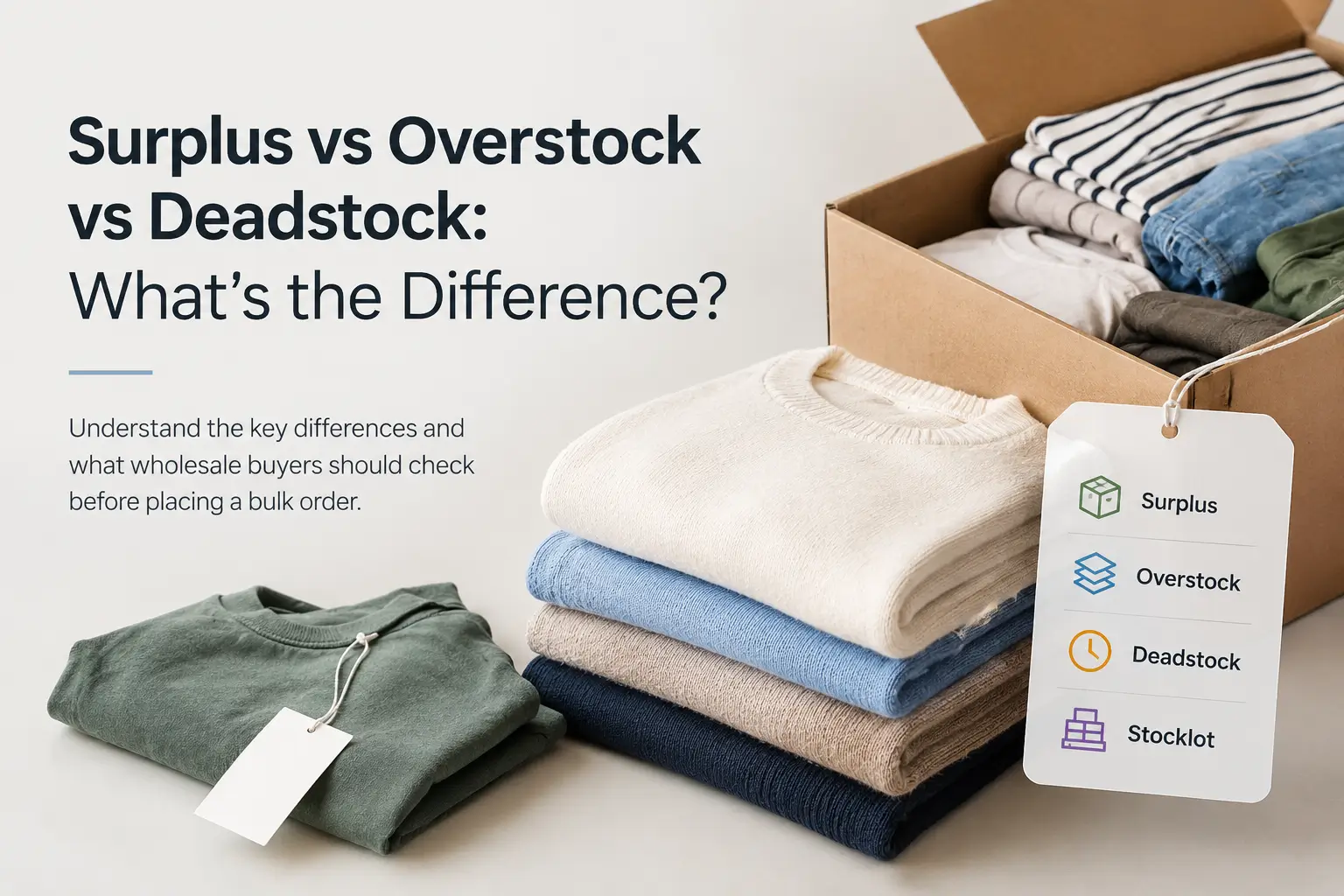
Surplus vs Overstock vs Deadstock: What's the Difference?
If you're sourcing ready stock apparel, you've probably come across terms such as surplus, overstock, deadstock, and stocklot. These terms are often used interchangeably in wholesale clothing, but they can describe different situations.
For buyers, understanding these differences is useful because the origin of inventory can affect availability, product age, quantity, and future replenishment.
However, the terminology used by suppliers is not always standardized. Instead of relying on the label alone, wholesale buyers should understand what each term generally means and ask specific questions about the actual stock.
Why These Terms Matter for Wholesale Apparel Buyers
Inventory terminology can give you an initial idea of why a batch of clothing is available for wholesale purchase.
For example, overstock may result from production exceeding demand, while deadstock may refer to goods left from a discontinued production run. A stocklot, meanwhile, describes how a batch is offered for sale rather than necessarily explaining where the inventory came from.
Understanding these distinctions can help buyers evaluate:
- How much inventory is currently available
- Whether the styles are current or from an older production run
- Whether the same products can be replenished
- What quality inspection has been performed
- Whether the supplier can provide consistent quantities
The important point is that inventory origin and product quality are two separate questions.
What Is Surplus Apparel?
Surplus apparel generally refers to inventory that exists beyond the quantity originally needed or sold through.
The term is relatively broad and can cover different types of excess inventory. For example, surplus may result from production exceeding the original requirement, additional quantities remaining after an order has been completed, or inventory that was not needed after demand changed.
Surplus does not automatically indicate poor quality or defective products.
For wholesale buyers, the more important questions are where the surplus came from, how long it has been stored, and how the supplier verifies its condition before shipment.
What Is Overstock Apparel?
Overstock apparel generally refers to clothing that was produced or purchased in quantities greater than the market demand.
For example, a manufacturer or retailer may have expected stronger sales for a particular style but still have a significant quantity remaining after the planned sales period.
Overstock can therefore include relatively current or recent styles.
For buyers, overstock can be attractive when the available quantity is large enough to support a wholesale order and the products remain commercially relevant to the target market.
However, availability may depend on the specific batch. Once the existing quantity is sold, the same style may not necessarily be produced again.
What Is Deadstock Apparel?
Deadstock generally refers to inventory that is no longer moving through its original production or sales cycle.
It can include:
- Older clothing styles
- Remaining inventory from a discontinued production run
- Products left after a brand or retailer stops selling a particular style
- Limited quantities from a previous production batch
Because deadstock is usually associated with inventory that is no longer part of an active sales or production cycle, quantities can be limited.
This makes deadstock different from an ongoing wholesale supply program where the same category can be replenished regularly.
Importantly, deadstock does not automatically mean defective or damaged clothing. The condition of the specific goods still needs to be confirmed with the supplier.
What Is a Stocklot?
Stocklot is commonly used in international wholesale trade to describe a defined batch or lot of ready stock goods offered for bulk purchase.
Unlike surplus, overstock, or deadstock, the term stocklot is more about how the inventory is offered for sale than why the inventory exists.
A stocklot could contain surplus inventory, overstock, discontinued styles, or other ready stock.
For example, a supplier may offer 2,000 pieces of mixed ready stock as one stocklot. The buyer would then evaluate the specific styles, sizes, quantities, condition, and pricing of that lot.
This is why asking what is included in a stocklot is more useful than assuming the term itself tells you the inventory's origin.
Surplus vs Overstock vs Deadstock vs Stocklot
TermWhat It Usually MeansWhat Buyers Should CheckSurplusExtra inventory beyond the original requirement or demandSource, age, condition, and quantityOverstockInventory produced or purchased in excess of demandCurrent relevance, available quantity, and replenishmentDeadstockInventory no longer active in its original production or sales cycleProduct age, condition, and remaining quantityStocklotA defined batch of ready stock offered for wholesale purchaseExact contents, quantities, sizes, and quality
These definitions are general rather than universal. Different suppliers and markets may use the terms differently.
For this reason, buyers should treat the terminology as a starting point rather than a guarantee about the inventory.
Does the Inventory Origin Affect Quality?
Not necessarily.
Surplus, overstock, deadstock, and stocklot are primarily descriptions of inventory status or origin. They do not automatically tell you whether the clothing is good or bad.
A reliable supplier should be able to explain how the goods are inspected before shipment regardless of the inventory category.
When evaluating wholesale stock clothing, ask about:
- Fabric and garment condition
- Visible defects or damage
- Stains, discoloration, or storage issues
- Size and quantity accuracy
- Packaging condition
- Quality inspection before shipment
This is particularly important when purchasing large quantities, because a low wholesale price does not compensate for unexpected quality issues across a large batch.
Can Overstock or Deadstock Be Replenished?
Usually, replenishment depends on the source of the inventory.
If the goods come from a discontinued production run, the exact same style may no longer be available once the remaining quantity is sold.
Overstock can sometimes be easier to replenish if the manufacturer still produces the style, but this should never be assumed.
For buyers who need ongoing supply, ask the supplier:
"Can this style be replenished after the current stock is sold?"
This simple question can help distinguish between a one-time stock opportunity and a more reliable ready stock supply.
If you are looking for ongoing availability rather than one-off liquidation lots, it may be more useful to work with a supplier that maintains a regularly available ready stock range.
What Should Buyers Ask Before Ordering?
The terminology alone is not enough to evaluate a wholesale apparel batch.
Before placing an order, ask the supplier for specific information about the actual inventory.
1. How many pieces are currently available?
Confirm the actual quantity available rather than relying on an old product listing.
2. Is the stock current or from an older production run?
Product age can matter depending on your target market and sales channel.
3. Can the same style be replenished?
If you expect repeat orders, confirm whether additional quantities may become available.
4. What quality checks have been completed?
Ask whether the garments have been inspected before packing and shipment.
5. Are there any defects or storage issues?
If the inventory has been stored for an extended period, ask about its condition and packaging.
6. Are sizes and quantities mixed?
For wholesale apparel, size ratios can be just as important as the total piece count.
These questions provide much more useful information than simply asking whether a product is "deadstock" or "overstock."
How BENTA STOCK Categorizes Ready Stock
At BENTA STOCK, we use straightforward availability categories rather than relying heavily on origin-based terminology.
Our ready stock products are generally classified as:
Ready Stock — Products with available inventory suitable for wholesale orders.
Limited Stock — Products with more constrained quantities that may sell out sooner and may not be replenished in the same way as regularly available stock.
This approach makes it easier for wholesale buyers to focus on what matters most when sourcing: what is available now, how much is available, and whether additional quantities can be expected.
Because inventory changes over time, buyers should confirm the latest stock status and available quantity before placing an order.
Frequently Asked Questions
Is deadstock lower quality than overstock?
Not necessarily. Deadstock and overstock describe different inventory situations, not a specific quality level. Product quality depends on how the garments were produced, stored, and inspected.
Is surplus clothing the same as overstock?
Not exactly. Overstock usually refers specifically to inventory exceeding expected demand, while surplus is a broader term for additional inventory beyond the original requirement or demand.
What is the difference between stocklot and deadstock?
Deadstock describes the status or origin of inventory, while stocklot generally describes a defined batch of goods offered for wholesale purchase. A stocklot can contain deadstock, overstock, surplus, or other ready stock.
Can I buy deadstock clothing in bulk?
Yes. Deadstock can be available in bulk, but quantities vary significantly depending on the remaining inventory. Buyers should confirm the exact quantity and size breakdown before ordering.
Can overstock clothing be replenished?
Sometimes, but not always. Replenishment depends on whether the manufacturer or supplier still has additional inventory or continues producing the same style.
How can I verify the condition of wholesale stock clothing?
Ask the supplier about its quality inspection process and request current product photos, available quantities, size breakdowns, and details of any known defects or storage issues before placing a bulk order.
Are surplus, overstock, and deadstock terms standardized?
No. Usage can vary between suppliers, regions, and wholesale markets. Always ask for specific information about the actual batch rather than relying only on the terminology.
Looking for Ready Stock Apparel?
If you're sourcing wholesale ready stock clothing, focus on actual availability, quantity, condition, and replenishment potential rather than the inventory label alone.
You can explore our Stock Product Categories to see the apparel categories currently available, or contact BENTA STOCK to ask about specific styles, quantities, and stock status.
For buyers who need to understand how minimum order quantities work when purchasing ready stock, see our guide: Wholesale Stock Clothing MOQ: What Buyers Should Know Before Ordering.
You can also read How to Buy Wholesale Stock Clothing from China for a step-by-step overview of the sourcing process.